Emil Waldvogel
The Master Butchers Singing ClubEmil Waldvogel, the son of Fidelis Waldvogel and Eva Waldvogel and twin brother of Erich Waldvogel, is a member of the younger generation whose life is marked by childhood companionship, bereavement, and an abrupt wartime death. His brief story moves from ordinary family routines and secret play to military service and death in the war; its consequences continue through Erich’s captivity and the family’s unsuccessful attempt to reconnect with him.
Identity and Family
Emil grows up in the Waldvogel household with his brothers Erich, Markus, and Franz. His twin bond with Erich is especially consequential: they expect to enter the war together and remain side by side, and Erich experiences Emil’s death as the loss of his other half. The evidence presents Emil through his place among his brothers and through the family’s daily care rather than through an independent adult life.
The household’s routine reveals both Fidelis’s responsibility and the boys’ differing needs. In the morning, Fidelis wakes the children, prepares milk with watery chocolate and oats, and makes coffee. Emil and Erich need particular care because they can fall asleep again almost immediately if left alone. One morning Emil appears in the kitchen wearing only one boot and blames Schatzie, the family dog, for hiding its mate. The small mishap gives a glimpse of a child still dependent on household routines, before war removes him from them altogether.
Childhood, Loss, and the Underground Fort
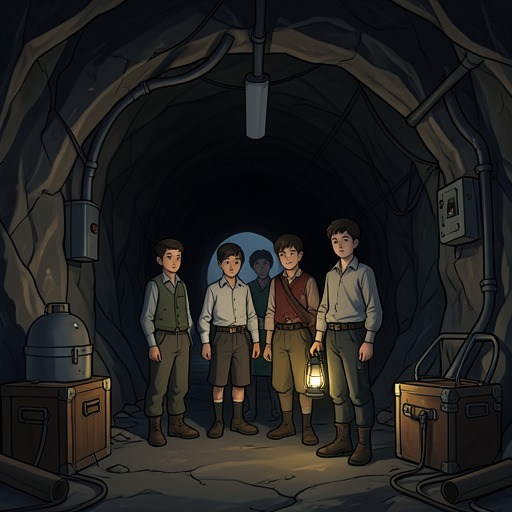
After Eva’s prolonged illness and death, the brothers’ childhood changes. A year after their mother dies, Markus becomes absorbed by an unfinished construction site near the woods and imagines turning the excavated ground into a fort. When he brings the idea home, Emil and Erich join him. The boys plan to reinforce tunnels with boards from an abandoned shed and branches, and Markus proposes that membership be restricted by a secrecy oath made solemn with hot wax on the inside of their wrists.
The fort becomes a shared project and a private world. The boys steal shovels, carry earth away on sheets taken from clotheslines, and store bread, apples, nuts, potatoes, and sausage ends for their gang. They work after school and into the evening by lanterns taken from barns and candles taken from home; some candles even come from the Catholic church. Their venture combines practical construction with ritual and defiance. Since Eva’s death, the Waldvogel boys have stopped attending both the Catholic and Lutheran churches, and the secrecy rites help express their sense of being abandoned and their rejection of a God who did not answer their prayers for their mother.
Emil is present when the mound collapses with Markus still inside. The other boys run for help, and Emil is among those who try to explain the disaster to Fidelis and Cyprian Lazarre. When Cyprian calls for shovels and organizes the response, the boys help the adults by carrying away the earth removed from the tunnel on canvas. The rescue effort places Emil among a community suddenly organized around finding his brother: the boys, Fidelis, Cyprian, Delphine Watzka, and the members of the singing club all gather at the site. Markus is eventually found and rescued, but the episode establishes the danger beneath the brothers’ play and the seriousness of their loyalty to one another.
Place in the Family
Emil’s childhood includes ordinary frictions as well as shared adventure. His missing boot irritates Fidelis, who orders him to find it while tending the stove. On another morning, Erich says he has found the boot and appears to want to hit his younger brother, but restrains himself. The moment gives their closeness a sibling’s rough edge: affection and responsibility coexist with impatience, and the boys are still learning how to manage their differences.
Years later, after Fidelis tells Franz and Markus that he has written and sent money to arrange the return of Emil and Erich, Markus asks whether this means both brothers are coming home. The question shows how the family’s plans continue to hold the twins together in memory, even though the war has separated them. The anticipated homecoming will not restore the family as it was: Emil is already dead, and Erich remains a prisoner of war.
Military Service and Death
Emil’s war is short. The army, desperate for reinforcements, takes the entire class from his Adolf Hitler Schule, including its teachers and platoon leaders; he does not need to lie about his age to be sent. He and Erich had planned to join the Hitlerjugend division of the Waffen SS and fight shoulder to shoulder. At the selection camp, both brothers are praised and identified as officer material.
Emil dies early in the conflict after stepping on a mine in a sheep pasture. His new uniform is destroyed before it has been worn into service. At the moment of the blast, he registers the green landscape and the unexpected sensation of being upside down in the air; he is dead before he reaches the ground. In his pocket is a picture of Tante Maria Theresa Waldvogel, soaked with blood. He also has honey candy in his mouth, which his grandmother had insisted he carry because she hoped the honey that had helped his father survive the earlier war might protect her grandson as well. The objects connect the abruptness of Emil’s death to the family’s effort to carry protection, memory, and inherited hope into a war where such safeguards fail.
Erich’s Loss and Narrative Significance
Emil’s death defines the rupture between the surviving twin and the family. Erich continues fighting after the mine kills his brother, but he is profoundly affected; the narrative describes him as already diminished by Emil’s death before his eventual capture. When Fidelis and Markus later visit a prisoner-of-war camp in Minnesota, Erich recognizes them but refuses to turn toward them. He has not yet learned that they do not know Emil has died. As he walks away, he thinks angrily of his brother, killed by one of the Americans’ land mines, and rejects what he sees as a sentimental attempt to reclaim him.
Emil therefore remains consequential even when absent from the later scenes. His death helps explain Erich’s refusal of reunion and his continuing allegiance to an idea of Germany formed through place, language, and memory. It also makes the family’s expectation that both twins might come home painfully impossible. Emil’s story is brief, but the gap left by his death persists in the surviving family’s plans and in Erich’s response to his father and Markus.